Saturday, July 27, 2019

Nomad's First Voyage To Mainland Portugal

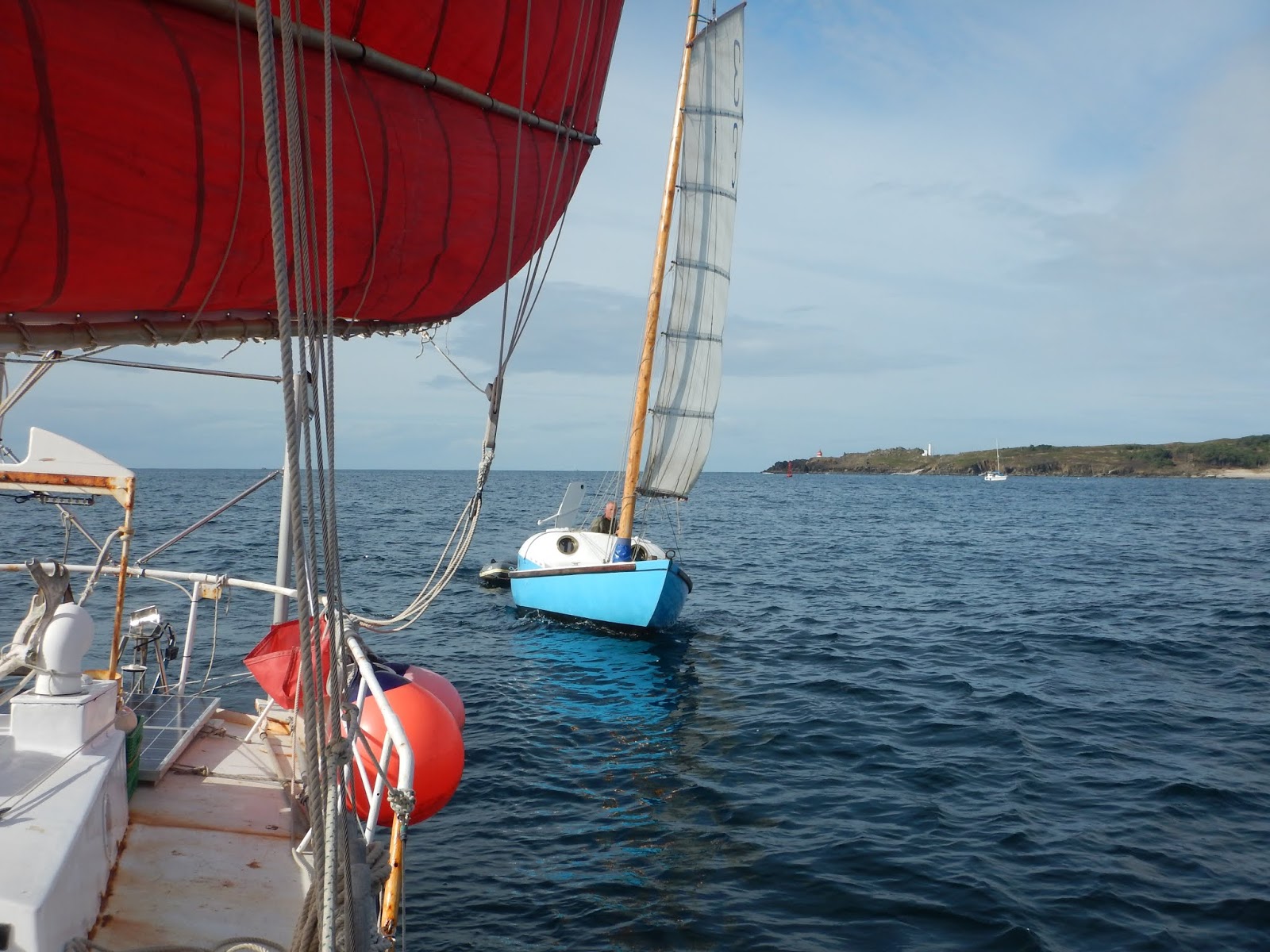
By the time Nomad worked her way around Punta Robaleira Spain the forecast gale force northerlies were beginning to build as the sun set.  I carefully approached the unlit beach in complete darkness with a close watch on the depthsounder. It was a relief to get anchored as there had been little respite from the heavy traffic all the way from England.  When the sun came up the next morning I found that the the only other boat in Enseada Barra was a small junk.  The forecast called for a day of brisk southerlies after the gale so we sailed in company across to Bayona Spain. This was an excellent opportunity for some good photos of each others boats under sail. Sailing with another junk was a rare chance to compare different rigs and see other methods of working our unique boats.
China Blue coming up fast

Nomad, as seen from China Blue

Nomad departed Bayona when the winds changed back to the prevailing northerlies.  But the winds were light offshore and there was a big swell left over from the recent winds.  Nomad was unable to maintain steerage in the troughs where there was no wind so it was time to play motorboat for twenty four hours until the wind and sea state allowed sailing.  After that it was easy sailing, having moved slightly further offshore to get out of the steady stream of traffic  moving along the coast.  Rounding Cabo Sao Vincente  brought Nomad into a different world. The wind became light before stopping altogether, the big Atlantic swell disappeared and the temperature became noticeably warmer. I put the anchor down inside the breakwater in Portimao Portugal five days after departing Bayona.

Sunset in Portimao Portugal.

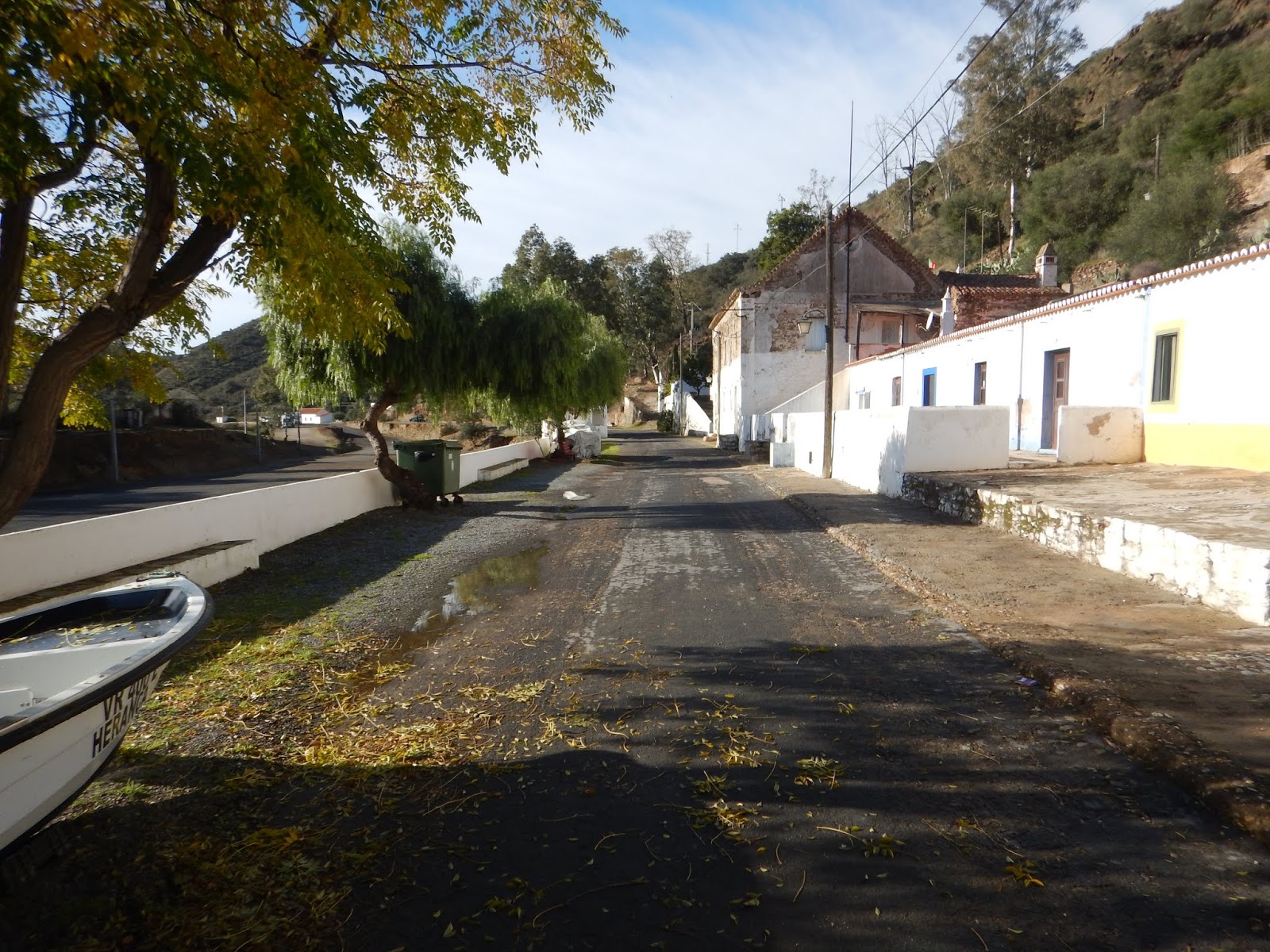
Portimao was a good city  to restock the boat in and visit. Seeking a quieter, less rolly anchorage I moved east to Culatra. The sea state in the entrance was a bit rough with the wind and tide opposed as I could not go quite fast enough to arrive at slack water. Here was a pleasant anchorage near a small fishing village that could only be reached by boat. The larger town of Olhao was just a dinghy ride across the drying sandbanks. Timing the tides is all important rowing across the sandbanks. One afternoon I lingered a little too long at a waterfront pub and had to get out and walk the dinghy across the sandbanks in not quite enough water to fully float it. Another fifteen minutes and I would have had several miles of rowing to get home!
This looked like  it was a good place to work on the boat, so I dismounted the windvane and got it on deck. I had noticed that the Delrin bearings were falling out of the bottom and decided that it was time to rebuild it. 
This overhaul was way overdue, I had done nothing except replace the plastic bits that got sun rotted and the control lines since I purchased it for my last boat. In1998!
Ready for a complete rebuild.

Some time ago I was told to check out the Rio Guadiana by another sailor. This was just a short sail to the Spain-Portugal border so I had no trouble timing arrival for high water. As the tide began to ebb it was time to anchor. I found a comfortable shoal out of the main channel before the bridge across from Ayamonte.  Riding the tide the next afternoon I went upriver to anchor off the twin towns of Alcoutim Portugal and Sanlucar Spain. Two countries, two time zones and two languages split by the Rio Guadiana. This river is  a sailors paradise with no commercial traffic and sailboats anchored everywhere. Village life or wilderness all nearby. There are quite a number of ex sailors living ashore here who arrived on their boats and never left. I thought I would explore the river for a few days before moving on. But the good living and active social life along the riverfront kept me here for well over a month including the Christmas and New Years celebrations.
Sanlucar de Guadiana as seen from Alcoutim


Sailboats everywhere on the Guadiana


Most days started like this.

Talking with people here I learned that it was possible to go with your boat as far upriver as Mertola which is much further than the chart goes. I set off with a copy of a very old guidebook and some notes  to explore the upper river. I moved slowly going hiking at every anchorage .  Eventually I got to a bend in the river and could not locate the channel at high tide. When the tide dropped I could see what I thought was deep water channel was completely blocked by boulders.  The next morning was spent exploring with the dinghy and lead line, finding the deep channel less than two meters from the bank. Getting around this bend at high tide was easy with a quick sketch chart of turning points I made in the dinghy. Nomad anchored further upriver a half mile below the ruins of an old Roman dam near Vau da Vaquiera. Reportedly one can pass over it at high tide. After an investigation with  lead line found that it is deep enough at high tide but there were a few random boulders scattered about  without a straight path through, I decided not to risk scraping up my bottom paint and go the last two miles to Mertola by dinghy. I had to wait for a few days for the tide times to be right to ride the tide up and back during daylight. Two days later a cold front came through with brisk shifting winds and Nomad began to slowly drag her anchor upriver. After several failed attempts to reset the anchor on a bottom that was apparently solid rock I hitched it up and headed downriver to Penha de Aguia to anchor in a nice mud bottom.

Downriver from Penha de Aguia

The remains of an old Roman era dam at Vau da Vaquiera . End of the road for Nomad

Time to start using two anchors in the narrow areas. The wind vane was bumping on the rocks as the tide turned.

Nomad's last anchorage before turning downriver. Three miles from Mertola.

Another spectacular Guadiana anchorage.
Pomerao is a very small village with two restaurants and a riverside parking are popular with caravans.  The big attraction here is the hiking into the countryside along many kilometers of old railways. After the mine closed, the tracks and bridges were dismantled and anything of value was removed. But the tunnels and bridge foundations remain. I spent a few days hiking extensively in the mountains behind Pomerao.
Anchored by Pomerao. Notice the wing dams upriver showing at low tide.

Pomerao

Anchored fore and aft in Pomerao. The boas on the docks were all long term storage with only a few sailors onboard.

Exploring the old railway tunnels.

Pomerao as seen from the highway above town.

Learning of a bamboo grove on the river, I located it and cut some fresh bamboo to replace some damaged battens. Nomad anchored again downstream of Alcoutim to install the new bamboo and work on the never ending fixit list.

With the ninety days allowed in the Schengen agreement countries fast running out and wanting to save a little bit for the Canary islands I reluctantly sailed back to Portimao to get a little fuel and clear out for Morocco.  Before losing the phone signal off shore I got an email from some friends who said they were still in the boatyard in Porto Santo. After a quick check of the weather forecast I changed course for Porto Santo and sent them a note saying that I will see you in a few days. Five days later Nomad was anchored inside the breakwater at Porto Santo. It was a great opportunity to catch up with old friends and do a lot of hiking around the island.  Hiking also provides spectacular views along the forbidding north side of the island which is a dangerous lee shore for boats.
The harbour at Porto Santo. In the background, Madeira on the right and Ilhas Desertas on the left.

The ocean is nearly always in sight on Porto Santo.

Porto  Santo's rugged north shore.

All to soon it was time to head for Gran Canaria and points south. There were still a few ports I wanted to visit enroute to The Gambia.  But the more time I spent enroute meant that the was less time available  for visiting The Gambia as I wanted to sail from there before the rainy season began.

Sunday, January 20, 2019

Ireland and UK

Sailing in the higher latitudes is never easy with frequent weather systems changing the winds every few days.
A few days out of Iceland the wind changed to south. Rather than drifting about and losing distance to the north, I kept Nomad as close hauled to the wind as possible, sailing east, then west. I tacked 75 miles from the Faroe islands resisting the urge to stop and visit, eventually arriving at a point only 10 miles north of where the wind turned against me.  After 100 miles of sailing and as planned the wind worked it way around to a usable direction.
The weather fax was now showing a gale force eight west winds arriving a day before I could make any port in Ireland. Deciding that it would be too risky to sail down the west coast in a westerly gale it was time for a change of plans, settling on Lough Swilley. With it's two mile wide entrance, entry should be possible in any conditions.
While in the process of reefing the main as the winds increased, I was quite startled to look forward and see that the jib was missing! It was all on deck and blowing about the bowsprit. Going forward to secure the jib the problem was apparent. The masthead block for the jib halyard had broken leaving me with no way to hoist the jib without a trip up the mast to replace it. Nomad sailed well enough with the wind on the quarter to make the coast, but when it was time to turn south and head down to enter Lough Swilley she lost all speed and I had had to resort to motorsailing to lay my course. This worked out well enough for as Nomad closed the shore the seas built up to  a very steep five meters on the beam. Without the sails to steady her it would have been impossible to hold that course.
As in any mountainous area as I got behind the headlands the sea decreased  and the wind began to align with the channel, resulting in a very strong headwind. It took Nomad over a hour to cover the last two miles to the beach in Ballymastocker Bay .
Safely at anchor, it was time for a much needed rest. Two days later the wind settled to a more manageable pace and I went to find a place to go ashore and clear in. Seeing a few sailboats in the distance, I headed for Rathmullen and found a pontoon to tie to.
Safely at anchor, it was time for a much needed rest. Two days later the wind settled to a more manageable pace and I went to find a place to go ashore and clear in.
Ireland is very green after being in the stark rugged scenery of the north
Nomad approaching Rathmullen


The local Garda station was closed, so I went to the first pub right at the end of the dock, ordered a pint of Guinness and asked the owner if she could call the Garda to report my arrival. They arranged for me to get a ride and meet with immigration in a nearby town in two days to get checked in.
My arrival was noted by the locals and was photographed for the local Facebook page.  It was a bit odd that the first person I talked with on the dock asked "How was my trip from Iceland?" He had seen Nomad anchored in Ballymastocker on the AIS and had checked me out on MarineTraffic .
The weather had settled so it was time to leave Rathmullen and start working my way around Ireland. This requires meticulous planning due to the frequent weather systems and the fierce tidal currents around the north and east coasts of Ireland.  A late night departure to catch the tide put Nomad into Ballycastle to ride out an overnight gale and wait for the morning tide.

Fair Head, the entrance to the Irish Sea

Nomad rounded Fair Head with the following current, reaching speeds a little over eight knots.  However  the fun only lasts for six hours, then the next six saw speeds down to two knots as we pushed against the tide. I pushed Nomad hard through the night to get into the lee of the shore for an approaching weather system. Unfortunately this put me at the Drogheda jetties right at low tide, so I had to heave to and wait for the tide to refill the river so I could enter. Navigation in Ireland is all about timing you travels with the tide. By late afternoon Nomad was at the Fiddle Case Pier in central Drogheda. With a thousand years of history to explore, every place in Ireland has many stories to tell.
Nomad's berth in Drogheda

St Laurence gate in Drogheda, remnants of the ancient city walls.

St Peter's Church in Drogheda. The churches in Ireland are among the most spectacular buildings in the country.

Drogheda was the beginning of a very special three weeks on Nomad. My Mom flew to Ireland to meet up with me and stay on the boat. This was her first ever overseas trip and the first time she had ever seen Nomad since I purchased her in 2003. With due care to pick flat water for traveling on the water she enjoyed traveling to Arklow and Waterford on Nomad.
Custom made Waterford crystal artwork.


Mount Congreve gardens, Kilmeaden
Waterford at night.

Tight parking on the pontoon, but it's a great location

Waterford is quite a ways up the river so it is completely protected from the ocean. There is quite a tidal current in the River Suir and with my usual luck arrived at the half flood with a few knots of current adding to the challenge of parallel parking on the pontoon. The Waterford pontoon was ideal for access for my Mom as it was level with my deck. It’s central location in Waterford was perfect for shopping and a short walk to the bus and train stations.  We explored the local history of Waterford and toured the Waterford Crystal factory with it’s impossibly high priced glass artwork. The bus brought us to Cahir and Cashel to explore their castles. We rode the train to Kilkenny and spent the day walking around town and touring the Smithwicks brewery.


The castle at Cashel Rock.

The castle at Cahir

Hore Abbey seen from Cashel Rock

Another exquisitely designed church in Waterford, including Waterford crystal chandeliers.

The bishops palace in Waterford, with Waterford crystal here,too.

Suir river narrow gauge railway
Mom enjoying Cahir castle
  When Mom decided it was time to head home, I focused on the weather, intent on getting across the Bay of Biscay quickly as it was getting late in the year. It seemed stable as far as I and the forecasters could tell so I took a chance to sail to Falmouth UK to meet up with some other junk sailors.  Arriving late in the day I made my way up the River Fal and tied to the second pontoon with only one other boat on it.
The entrance to historic Falmouth harbor, UK


Nomad on the pontoon, River Fal. These pontoons are not connected to shore, so it's nearly as nice as being at anchor.
 Lynda and David from the Junk Rig Association sailed their boat up to the pontoon to meet me. Later I moved back downriver to a more convenient location anchored in front of Trelissick House.  My time in the River Fal was all too brief, I never even got to visit the town of Falmouth. Three days after arriving, the forecast showed a five day period with northerly winds and no gales to Cape Finisterre. I forgot all ideas of checking out the neighborhood and got underway quickly to get across Biscay non-stop.  For a change, the forecast was accurate, the gale began building right on schedule as I turned into a protected anchorage to wait out the weather.

Tuesday, November 20, 2018

Iceland, Nomad's visit to the land of fire and ice.

Nomad departed her winter berth in Conception Bay South Newfoundland  on 04 July to head  North once again.  Destination : Iceland, with a possible stop in South Greenland  conditions permitting.  In light winds, I motorsailed for two and a half days to get clear of the Grand Banks before an approaching weather system caught up with me. Nomad cleared the Banks just north of the Flemish Cap with a little time to spare.  The wind built to near gale strength as forecast from the south which put the wind on the quarter, Nomad’s fastest point of sail. It was a wet and uncomfortable ride but the wind was steady so I was able to carry a good amount of sail without worries of being over canvassed in gusts.  By noon the following day conditions were easing  and Nomad had logged her best ever twenty four hour run of 186 miles.
Wind and current kept me to the west of the rhumb line to Iceland and about and I got within 250 miles from Prins Christian Sund in Greenland .  The wind became light and I was motorsailing again when I noticed that Nomad was only making 2.5 knots.  Checking the gearbox temperature and finding it was getting warm, I shut it down . This evoked a healthy bit of impolite language from me. After the troubles in Greenland last year, the gear was still not working right, so I paid a highly regarded transmission shop in Newfoundland to rebuild it for me since I could not find the problem with it. When it was cool, experimentation showed that it could be run at 1110 rpm before it started warming up due to slippage. I decided not to motorsail and save it for making the harbor in Iceland.  This was a frustrating moment as I turned away from Prins Christian Sund for the second time in as many years.  Being familiar with the conditions in Greenland’s fjords and not wanting to attempt to sail in them without reliable auxiliary power the course was changed to Reykjavik.  Once behind the peninsula approaching Reykjavik the wind quit completely and Nomad tediously made her way into the harbor  under power at two to three knots.
After two unsuccessful attempts at repairing the gear box it became apparent that the only solution left was replacement.  Shipping to Iceland from Europe is surprisingly expensive.  I could fly one way to the USA for the same cost as shipping a new gear from Europe. So six days after arriving in Iceland I flew to the USA and did a couple short jobs, flying back to Reykjavik with a new gear as a “personal item” carry on.
Nimad at the Brokey Sailing Club docks in Reykjavik.

The Harpa concert hall at night. The Brokey Sailing Club is conveiconven located right in the heart of Reykjavik.
It was now the middle of August and darkness was returning at night.  It was time to start working my way around the island and head south to avoid repeating last year’s weather challenges from staying in the north too late in the season.  I took a short bus trip to catch a glimpse of the interior and reluctantly set sail out of Reykjavik only seven days after returning to Nomad. As long as I kept moving in the right direction, there was time for a little exploring on the way.
Reykjanes Aukaviti

Iceland' s geography is quite interesting. Hot springs...

Geysers...

Even the ditches along the road have hot water in them.
Twenty six hours out of Reykjavik, Nomad was rafted up to the F/V Maggy  in the very secure harbor  in Vestmannaeyjar  island.  A volcanic eruption had made the island larger and nearly closed off the harbor entrance a few years back. The resulting narrowing of the entrance provides a nearly surge free harbor even when a storm is blowing directly in.  There are a number of walking trails and some good climbing around the island. 
Nomad's berth in Vestmannaeyjer

Vestmannaeyjer town from the 290 meter Heimaklettur.

Entry to the snug Vestmannaeyjer harbor.

Vestmannaeyjer dead ahead after a long day and night

Like all Icelandic towns, there’s the usual public pool. Thanks to abundant geothermal  energy there is no shortage of hot water. Public pools all have warm swimming pools, hot tubs and steam rooms.  No reason to shower on the boat when one can shower at the pool and then spend half a day playing in warm water.
Vatnajokull glacier close to the ocean.

The haborh in Hofn, up the Hornafjordur

Vatnajokull icecap and glacier.
A day and a half sail from Vestmannaeyjar islands brought Nomad to the town of Hofn  in Hornafjordur.  Sailing along the coast provided great views of the nearby ice cap and mountains.  Despite my best efforts at keeping Nomad moving briskly I missed slack water at the Hornafjordur jetties by two hours.  The seas were beginning to break partway across the entrance as the outgoing tide met the swell.  The new gearbox worked without complaint as I powered against the ebb current, occasionally slowed to 1.5 knots.  Slowly Nomad made her way through the harbor and found a dock to lay on in the inner basin at 2130.  Hornafjordur  is on the SE corner if Iceland  making it the logical place to head south from.   I spent a pleasant but all to brief visit checking out the area including several visits to the local pool.  Ever mindful of the lateness of the season and increasing storm frequency  I sailed for Ireland after only four days here.  Iceland  makes clearing  out simple. Once I saw the weather forecast was in my favor, I called Iceland Coast Guard radio on the VHF for clearance. They instructed me to scan and email them the documents and  by the next morning clearance papers arrived via email and I was able to leave promptly at high tide.  Iceland is another place that I would like to visit again and spend more time exploring their fascinating culture and geography.